The whole book on one page

Bhagavad Gita summary: all 18 chapters

What happens, what it teaches and the verse to remember from every chapter — in plain English, in about ten minutes.
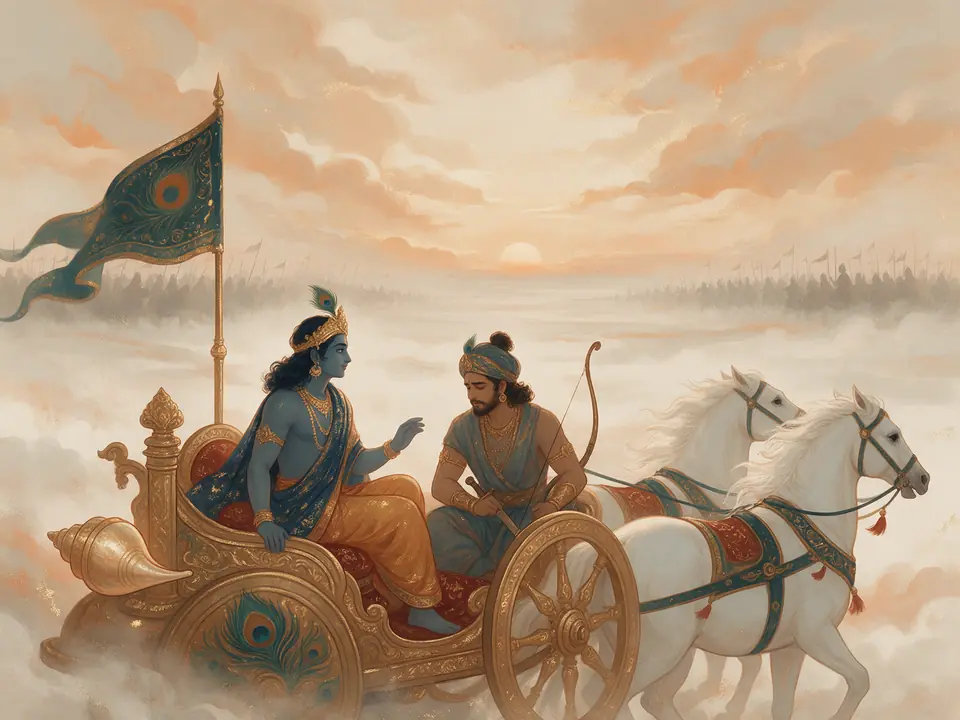
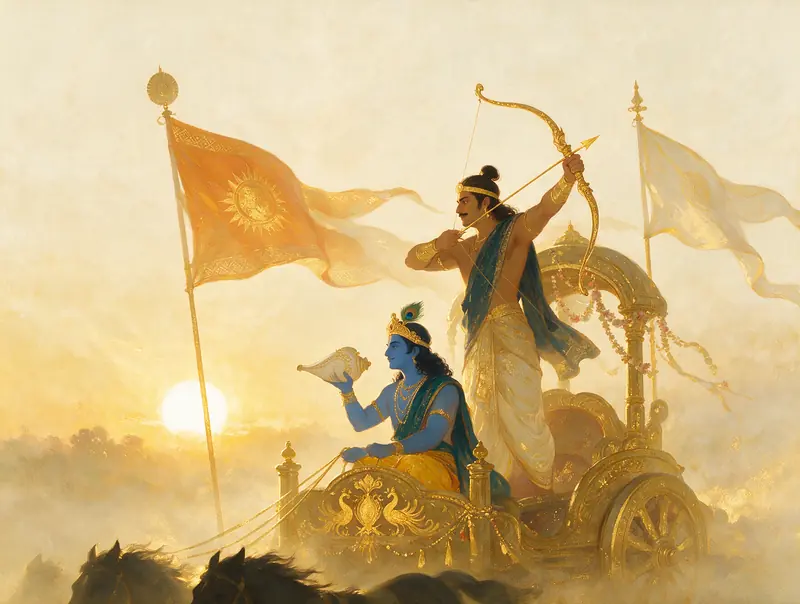
Krishna counselling Arjuna on the chariot between two armies

The Gita in 60 seconds

On the morning of a great war, the warrior Arjuna looks across the battlefield, sees his own family on the other side, and collapses: he will not fight. His friend and charioteer Krishna — who turns out to be the divine in human form — talks him through it. In 700 verses Krishna explains that we are not our bodies or our fears but an undying self; that we should do our work fully without being ruled by the results; that a trained mind becomes our best friend; and that love and surrender are the simplest path of all. By the end, Arjuna’s confusion is gone and he stands up, clear about who he is and what is his to do.

The story in four moments

  1. 1A family at warTwo branches of one royal family, cousins who grew up together, are fighting over a kingdom. After every attempt at peace fails, two huge armies face each other on a plain called Kurukshetra, in northern India.
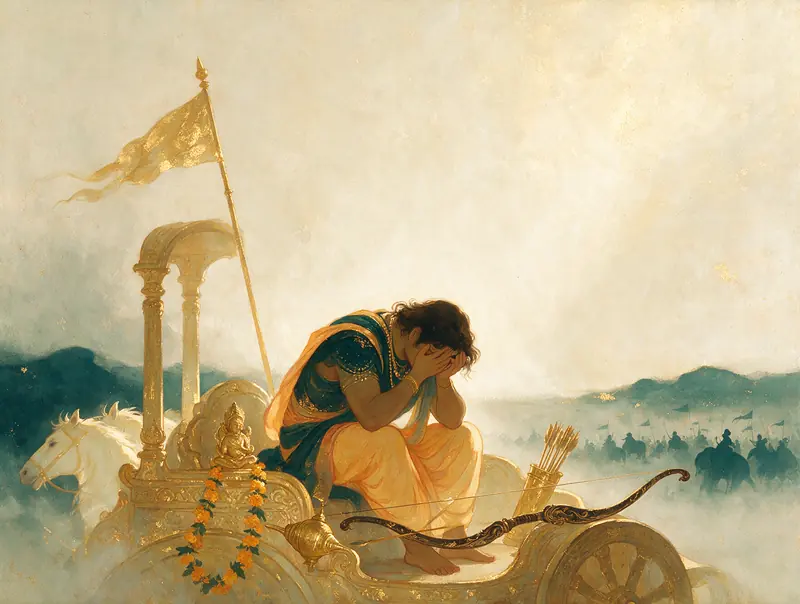
  2. 2A hero freezesArjuna, the best archer alive, asks his friend Krishna — who is driving his chariot — to stop between the armies. He sees his teachers, cousins and friends on the other side. He drops his bow, shaking: “I can’t do this.”
  3. 3A conversationRight there, before the first arrow flies, Krishna talks him through it. 700 verses on fear, duty, death, the mind, purpose and love. Arjuna pushes back, asks hard questions and gets honest answers.
  4. 4ClarityBy the end, Arjuna’s confusion has lifted. He isn’t told what to feel. He understands who he is and what is his to do — and he stands up.

Six lessons to take away

  1. Lesson 1You are more than your thoughtsUnderneath your body, moods and memories is awareness itself — the part of you that notices everything else. The Gita says this deepest self was never born and never dies. Fear loosens its grip when you know what can’t be harmed.Gita 2.20 →
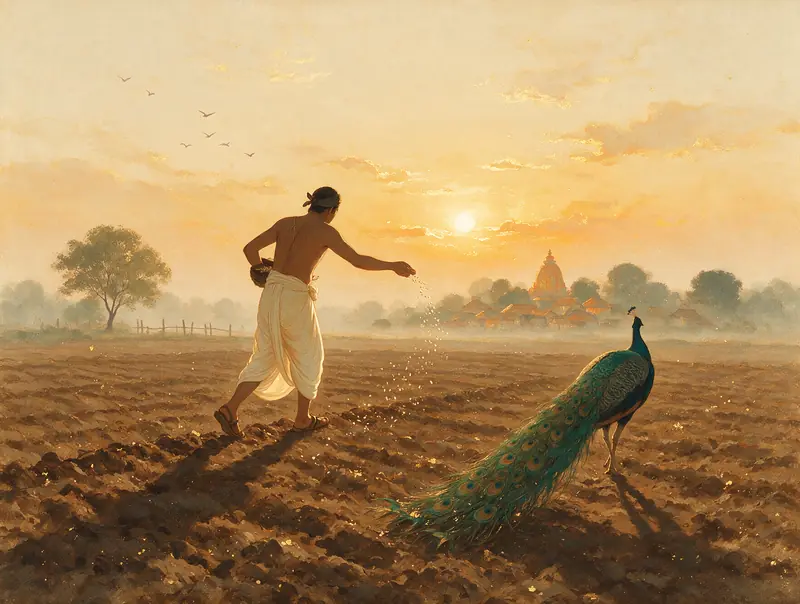
  2. Lesson 2Do the work, release the outcomeYou control your effort, never the result. Pour yourself fully into what you do, then let go of the scoreboard. Anxiety lives in the gap between effort and outcome — this closes it.Gita 2.47 →
  3. Lesson 3Evenness is strengthSuccess and failure, praise and blame will keep coming. A steady mind that doesn’t swing wildly with them isn’t cold — it’s free. The Gita calls this evenness “yoga”.Gita 2.48 →
  4. Lesson 4Your mind can be your friendAn untrained mind works against you; a trained one is your best ally. It’s hard — Arjuna says it’s like controlling the wind — but practice and letting go work.Gita 6.5 →
  5. Lesson 5Three moods run your dayClarity, restless drive and heavy inertia — everything in nature, including your mind, is a mix of these three. Notice which one is in charge right now, and you stop being run by it.Gita 14.5 →
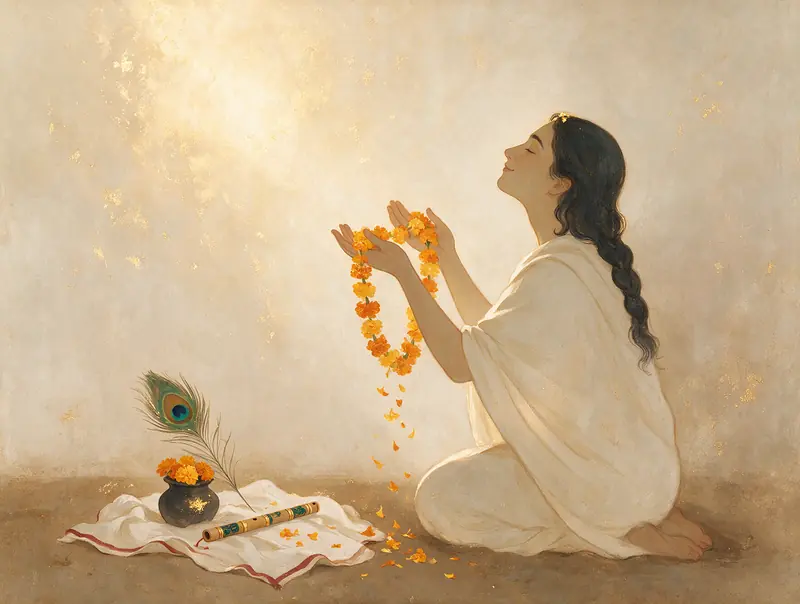
  6. Lesson 6Love is the shortcutPhilosophy is one path; devotion is another, and the Gita calls it the easiest. A leaf, a flower or a little water offered with love is enough. Its closing promise: let go, trust, and don’t be afraid.Gita 18.66 →

Part one · Chapters 1–6

Action: crisis, the self, and how to act without anxiety

  1. Chapter 1: A hero falls apart

    Chapter 1 · 47 verses · 16 min

    A hero falls apart (Arjuna Visada Yoga)

    Facing his own family across the battlefield, the hero Arjuna breaks down and refuses to fight.

    The lesson: Why even the strongest people fall apart — and why that moment is where wisdom begins.

    “Arjuna drops his bow and sinks down, overwhelmed with grief.” 1.47
    Read chapter 1
  2. Chapter 2: Who you really are

    Chapter 2 · 72 verses · 24 min

    Who you really are (Sankhya Yoga)

    Krishna’s first answer: you are not your fear. The deepest self is never born and never dies.

    The lesson: The whole Gita in miniature — the self, the art of working without anxiety, the steady mind.

    “You have a right to your actions, never to their results.” 2.47
    Read chapter 2
  3. Chapter 3: Why action matters

    Chapter 3 · 43 verses · 14 min

    Why action matters (Karma Yoga)

    If peace is the goal, why act at all? Krishna explains why doing your work beats running from it.

    The lesson: How to act fully without being eaten up by the outcome.

    “Better your own path done imperfectly than someone else’s done perfectly.” 3.35
    Read chapter 3
  4. Chapter 4: Wisdom in action

    Chapter 4 · 42 verses · 14 min

    Wisdom in action (Jnana Karma Sanyasa Yoga)

    Krishna reveals the teaching is ancient — and that he returns whenever goodness is in danger.

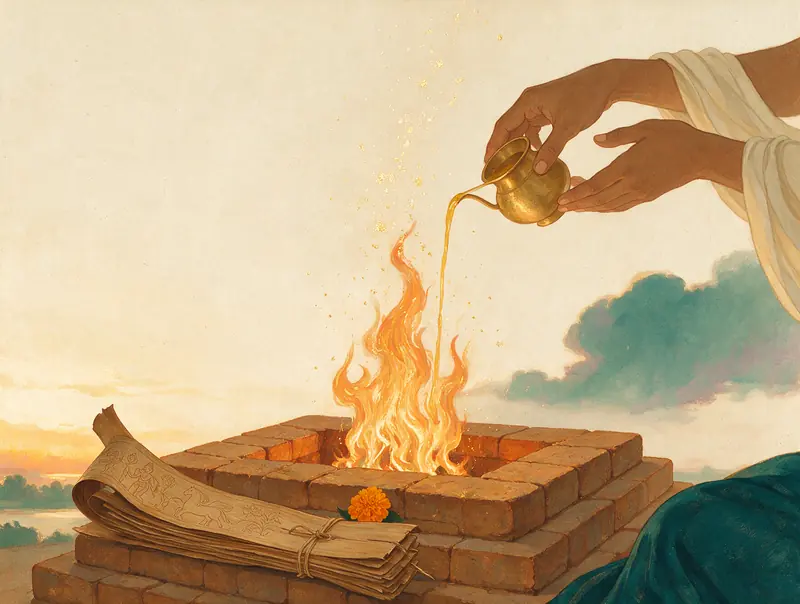
    The lesson: Knowledge as a fire that burns away guilt and confusion.

    “Whenever goodness fades and wrongdoing rises, I appear.” 4.7
    Read chapter 4
  5. Chapter 5: Freedom while fully engaged

    Chapter 5 · 29 verses · 10 min

    Freedom while fully engaged (Karma Sanyasa Yoga)

    Renounce the world or work in it? Krishna: let go on the inside, keep working on the outside.

    The lesson: Freedom that doesn’t require quitting your life.

    “Act without clinging, like a lotus leaf that water cannot wet.” 5.10
    Read chapter 5
  6. Chapter 6: Taming the mind

    Chapter 6 · 47 verses · 16 min

    Taming the mind (Dhyana Yoga)

    The Gita’s meditation manual — how to sit, breathe and steady a mind that won’t stop.

    The lesson: Practical steps to make your mind your friend instead of your enemy.

    “Lift yourself by your own effort — be your own best friend.” 6.5
    Read chapter 6

Part two · Chapters 7–12

Love: the divine in everything, and the path of devotion

  1. Chapter 7: Seeing the divine in everything

    Chapter 7 · 30 verses · 10 min

    Seeing the divine in everything (Gyaan Vigyana Yoga)

    Krishna moves from method to vision: everything that exists rests on one reality.

    The lesson: Seeing the sacred running through ordinary things.

    “Everything is strung on me like pearls on a thread.” 7.7
    Read chapter 7
  2. Chapter 8: What lasts beyond death

    Chapter 8 · 28 verses · 9 min

    What lasts beyond death (Akshara Brahma Yoga)

    Arjuna asks what happens when we die. The answer: what you keep returning to, you become.

    The lesson: Why your daily attention shapes your whole life — and its end.

    “Whatever fills your mind at the end is where you go.” 8.6
    Read chapter 8
  3. Chapter 9: The open secret

    Chapter 9 · 34 verses · 11 min

    The open secret (Raja Vidya Yoga)

    “The royal secret” turns out to be astonishingly simple: love is enough.

    The lesson: You don’t need to be perfect, learned or wealthy to be close to the divine.

    “A leaf, a flower, a fruit or a little water, offered with love — I accept it.” 9.26
    Read chapter 9
  4. Chapter 10: Glimpses of the infinite

    Chapter 10 · 42 verses · 14 min

    Glimpses of the infinite (Vibhooti Yoga)

    Krishna lists “glimpses” of the infinite — the sun among lights, the ocean among waters.

    The lesson: How to recognise greatness and beauty as windows onto something larger.

    “I am the self seated in the heart of every being.” 10.20
    Read chapter 10
  5. Chapter 11: The vision of everything

    Chapter 11 · 55 verses · 18 min

    The vision of everything (Vishwaroopa Darshana Yoga)

    Arjuna asks to see the infinite with his own eyes — and Krishna shows him everything at once.

    The lesson: Awe, perspective, and the humility that comes from seeing the whole picture.

    “I am Time, the mighty destroyer of worlds.” 11.32
    Read chapter 11
  6. Chapter 12: The path of love

    Chapter 12 · 20 verses · 7 min

    The path of love (Bhakti Yoga)

    The shortest chapter and one of the most loved: the path of devotion, step by step.

    The lesson: A portrait of the kind, steady, forgiving person — the one Krishna calls dear.

    “Someone who hates no one and is kind to all is dear to me.” 12.13
    Read chapter 12

Part three · Chapters 13–18

Understanding: mind, matter, character — and the final letting go

  1. Chapter 13: The field and the knower

    Chapter 13 · 35 verses · 12 min

    The field and the knower (Ksetra Ksetrajna Vibhaaga Yoga)

    A sharp lens: your body and mind are “the field”; you are the awareness that knows it.

    The lesson: Stepping back from your thoughts instead of drowning in them.

    “Know me as the knower in every field.” 13.3
    Read chapter 13
  2. Chapter 14: The three moods of nature

    Chapter 14 · 27 verses · 9 min

    The three moods of nature (Gunatraya Vibhaga Yoga)

    Clarity, restless drive and heaviness — three moods that run everything, including you.

    The lesson: A simple tool to notice which mood is in charge, and step out of it.

    “Clarity, passion and inertia bind the self to the body.” 14.5
    Read chapter 14
  3. Chapter 15: The upside-down tree

    Chapter 15 · 20 verses · 7 min

    The upside-down tree (Purushottama Yoga)

    The world as a vast tree with roots above and branches below, fed by desire.

    The lesson: How to cut through endless wanting and find what is lasting.

    “An eternal tree with its roots above and branches below.” 15.1
    Read chapter 15
  4. Chapter 16: Two kinds of character

    Chapter 16 · 24 verses · 8 min

    Two kinds of character (Daivasura Sampad Vibhaga Yoga)

    Two kinds of character side by side: the qualities that free us and the ones that trap us.

    The lesson: An honest mirror — and the three “gates” to avoid.

    “Three gates to self-destruction: lust, anger and greed.” 16.21
    Read chapter 16
  5. Chapter 17: You are what you trust

    Chapter 17 · 28 verses · 9 min

    You are what you trust (Sraddhatraya Vibhaga Yoga)

    “You are what you trust.” Everyday habits — food, effort, giving — sorted by the three moods.

    The lesson: Small daily choices that make the mind lighter and clearer.

    “A person is made of their faith.” 17.3
    Read chapter 17
  6. Chapter 18: Letting go — and standing up

    Chapter 18 · 78 verses · 26 min

    Letting go — and standing up (Moksha Sanyaas Yoga)

    The grand finale gathers every thread — and Arjuna, clear at last, picks up his bow.

    The lesson: Letting go and standing up are the same move.

    “Let go of everything, take refuge in me. Don’t be afraid.” 18.66
    Read chapter 18

You know the whole story. Now live it.

Common questions

What is the main message of the Bhagavad Gita?

Do your duty fully, without being attached to the results; know that your true self is eternal; train the mind; and act out of love rather than fear. Its most famous line, 2.47, sums it up: you have a right to your actions, never to their results.

How long does it take to read the Bhagavad Gita?

About 4 hours for all 18 chapters in plain English — or 15–20 minutes a day for two weeks. Chapter 2 alone gives you the heart of it in about 25 minutes.

Which chapter should I read first?

Chapter 2, “Who you really are”. It contains the core teachings — the undying self, working without anxiety and the steady mind. Then read Chapter 12 (the path of love) and Chapter 6 (meditation).

Is the Bhagavad Gita a religious book?

It is sacred scripture in Hinduism, and also one of the world’s great works of philosophy and psychology. People of every faith and none read it for its practical wisdom about fear, purpose and peace of mind.