Chapter 18 of 18 · 78 verses · 26 min
Bhagavad Gita chapter 18: Letting go — and standing up
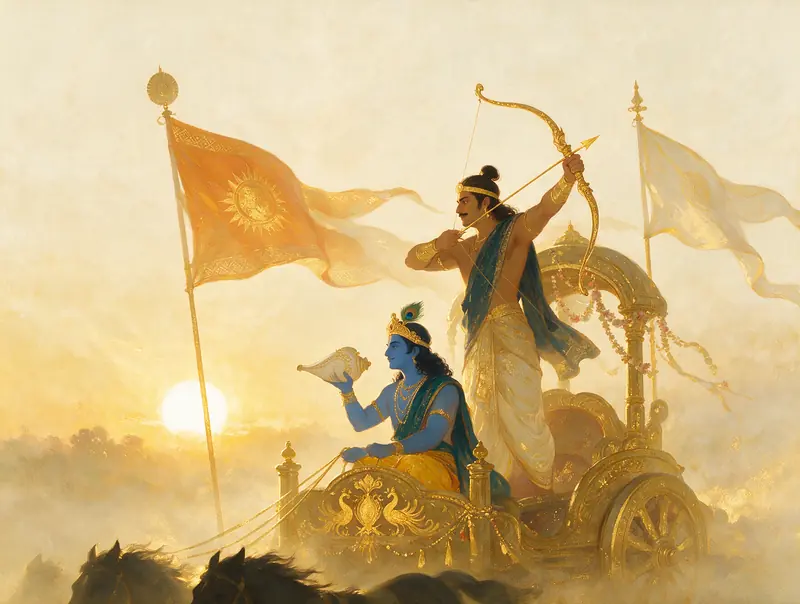
The grand finale gathers every thread — and Arjuna, clear at last, picks up his bow.
The grand finale gathers every thread. True renunciation isn't quitting your life; it's doing your work fully while letting go of selfish attachment to results. Krishna maps knowledge, action, determination and happiness through the three moods of nature — including the famous insight that real joy often tastes like poison at first and nectar in the end. Then the most loved promise in the Gita: “Let go of everything else and come to me. I will free you. Don't be afraid.” Arjuna's confusion is gone. He picks up his bow.
The line to remember · 18.66“Let go of everything, take refuge in me. Don’t be afraid.”All 78 verses — tap any one to read it
- 18.1Arjuna asks: “What does letting go really mean?”
- 18.2“Letting go means not clinging to the results of what you do.”
- 18.3“Some say stop everything. Others say keep doing good things.”
- 18.4“Here is what I think about letting go.”
- 18.5“Never stop helping, giving and growing. These make you better.”
- 18.6“But do them without clinging to rewards.”
- 18.7“Quitting your duties out of confusion is not right.”
- 18.8“Quitting because it’s hard doesn’t help either.”
- 18.9“Doing what’s right, without clinging — that is true letting go.”
- 18.10“A wise person doesn’t hate hard work or cling to easy work.”
- 18.11“You can’t stop doing things. But you can let go of the results.”
- 18.12“Those who let go aren’t tied up by what happens.”
- 18.13“Every action has five causes.”
- 18.14“Your body, your will, your senses, your effort — and God’s plan.”
- 18.15“Everything we do comes from these five.”
- 18.16“Thinking ‘I alone did it’ is a mistake.”
- 18.17“Someone free of ego isn’t trapped by their actions.”
- 18.18“Knowing, the thing known and the knower make us act.”
- 18.19“Knowing, doing and doers come in three kinds.”
- 18.20“The best way of seeing: one spirit in everyone.”
- 18.21“A lesser way: seeing everyone as totally separate.”
- 18.22“The worst way: thinking one small thing is everything.”
- 18.23“The best work is done calmly, without wanting a prize.”
- 18.24“Work done just to get things, with stress, is restless.”
- 18.25“Work done carelessly, without thinking of harm, is dull.”
- 18.26“The best worker is humble, steady, cheerful, and calm in success or failure.”
- 18.27“A greedy, harmful, up-and-down worker is restless.”
- 18.28“A lazy, rude, gloomy worker who puts things off is dull.”
- 18.29“Now hear about three kinds of understanding and willpower.”
- 18.30“Clear understanding knows when to act, when to stop, and what is safe.”
- 18.31“Muddled understanding mixes up right and wrong.”
- 18.32“Dark understanding sees everything backwards.”
- 18.33“Strong willpower keeps your mind and breath steady.”
- 18.34“Willpower only for money and fun is restless.”
- 18.35“Clinging to fear, sadness and laziness is dull.”
- 18.36“There are three kinds of happiness. The best one ends suffering…”
- 18.37“…it feels hard at first but becomes sweet like nectar.” — real happiness takes practice.
- 18.38“Happiness from treats feels sweet first, then turns sour.”
- 18.39“Happiness from laziness and too much sleep fools you from start to end.”
- 18.40“Everything in the world has these three moods.”
- 18.41“People have different gifts: teachers, protectors, makers and helpers.”
- 18.42“Teachers are calm, patient, honest and wise.”
- 18.43“Protectors are brave, strong, skilled and generous.”
- 18.44“Farmers and traders grow and share. Helpers serve.”
- 18.45“By doing your own work well, you find happiness.”
- 18.46“Doing your work well is a way of thanking God.”
- 18.47“Better to be yourself imperfectly than to copy someone else perfectly.”
- 18.48“Every job has some problems, like every fire has some smoke. Don’t give up.”
- 18.49“A free heart that clings to nothing finds the highest peace.”
- 18.50“Now hear how such a person reaches God.”
- 18.51“With a clear mind and steady will, letting go of likes and dislikes…”
- 18.52“…living simply, eating lightly, meditating, wanting little…”
- 18.53“…free of pride, anger and ‘mine’, at peace — they are ready.”
- 18.54“Calm, never grieving or craving, seeing all as equal, they love me deeply.”
- 18.55“Through love, they truly know me and come home to me.”
- 18.56“Even while busy, those who lean on me reach my home through grace.”
- 18.57“In your heart, give all your work to me. Keep your mind on me.”
- 18.58“With your mind on me, you will get past every obstacle.” — you won’t face your problems alone.
- 18.59“Saying ‘I won’t’ out of pride won’t work. Your nature will make you act.”
- 18.60“You will end up doing what you were made to do.”
- 18.61“God lives in every heart, guiding everyone.”
- 18.62“Trust God with all your heart and you will find perfect peace.”
- 18.63“I have told you everything. Think it over, then choose for yourself.” — the Gita trusts you to decide.
- 18.64“One more thing, because you are so dear to me.”
- 18.65“Think of me, love me, bow to me. You will come to me — I promise.”
- 18.66“Let go of everything else and hold on to me. I will set you free. Don’t be afraid.” — the Gita’s final promise.
- 18.67“Don’t force this on people who don’t want to hear it.”
- 18.68“Whoever shares it lovingly with seekers will come to me.”
- 18.69“No one is dearer to me than that person.”
- 18.70“Whoever studies this talk honours me.”
- 18.71“Even just listening with trust brings blessings.”
- 18.72“Did you listen closely, Arjuna? Is your confusion gone?”
- 18.73Arjuna says: “My confusion is gone. I remember who I am. I’ll do what is right.” — the story’s happy ending.
- 18.74Sanjaya says: “Hearing this amazing talk gives me goosebumps.”
- 18.75“By a sage’s blessing, I heard it straight from Krishna.”
- 18.76“Every time I remember it, I feel joy.”
- 18.77“Remembering Krishna’s amazing form, I feel wonder again and again.”
- 18.78“Where Krishna and Arjuna stand together, there is always goodness, victory and wisdom.”
Traditional summary
Moksha Sanyaas Yoga: Yoga through the Perfection of Renunciation and Surrender
The eighteenth chapter of the Bhagavad Gita is Moksha Sanyas Yoga. Arjuna requests the Lord to explain the difference between the two types of renunciations - sanyaas(renunciation of actions) and tyaag(renunciation of desires). Krishna explains that a sanyaasi is one who abandons family and society in order to practise spiritual discipline whereas a tyaagi is one who performs their duties without attachment to the rewards of their actions and dedicating them to the God. Krishna recommends the second kind of renunciation - tyaag. Krishna then gives a detailed analysis of the effects of the three modes of material nature. He declares that the highest path of spirituality is pure, unconditional loving service unto the Supreme Divine Personality, Krishna. If we always remember Him, keep chanting His name and dedicate all our actions unto Him, take refuge in Him and make Him our Supreme goal, then by His grace, we will surely overcome all obstacles and difficulties and be freed from this cycle of birth and death.