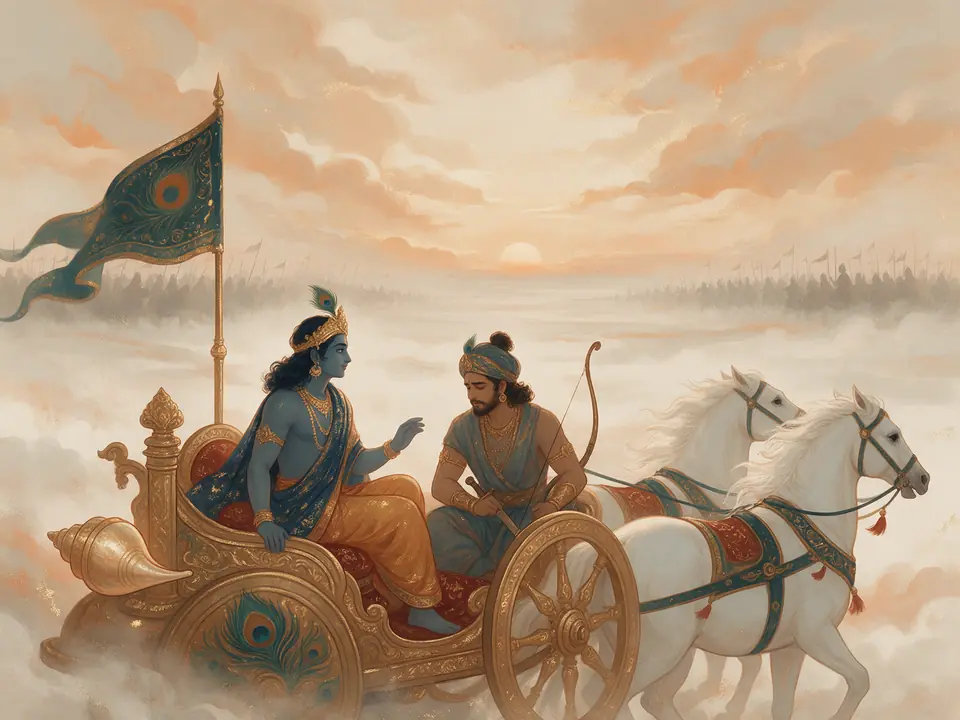
- Bhagavad GitaBUH-guh-vud GEE-tah
- “The Song of the Divine One.” A 700-verse conversation, part of the much longer epic, the Mahabharata.
- DharmaDAR-muh
- What is right for you to do — your duty, your nature and the order that holds life together.
- KarmaKAR-muh
- Action, and the results that come from it. Not fate: what you do now shapes what comes next.
- YogaYOH-guh
- Literally “joining”. In the Gita, not postures but any path that unites you with what is real: action, love, knowledge or meditation.
- AtmanAHT-mun
- Your deepest self — pure awareness, beneath body and mind.
- BrahmanBRAH-mun
- The infinite reality behind everything. The Gita says the self and the infinite are, at root, one.
- GunasGOO-nuz
- The three “moods” of nature: sattva (clarity), rajas (restless drive) and tamas (heaviness).
- BhaktiBUK-tee
- Devotion; love directed towards the divine.
- JnanaGYAH-nuh
- Wisdom; direct understanding of what is real.
- MokshaMOKE-shuh
- Liberation — freedom from suffering and from the cycle of birth and death.
- Samsarasum-SAH-ruh
- The cycle of birth, death and rebirth.
- MayaMAH-yuh
- The power that makes the world seem separate from the divine; often translated “illusion”.
- Omohm
- A sacred sound representing the infinite, chanted at the start of prayers and practices.
- ShlokaSHLOH-kuh
- A verse. The Gita is written in Sanskrit shlokas, usually two lines each.
- Kurukshetrakoo-roo-SHAY-truh
- The battlefield where the Gita is spoken — and, symbolically, the inner battlefield of every life.
- Mahabharatamuh-hah-BAH-ruh-tuh
- The great epic of India, one of the longest poems ever written. The Gita is a small part of it.